IQ 12: Introducing a New Fellowship, AY26-28 Fellows, Fantasy in Oxford, Dinner & Dialogue
Inklings Quarterly
October 21, 2026
The Inklings Project Welcomes Its First Cohort of Middle and High School Teachers
By Leonard DeLorenzo, Ph.D.
“The librarian tells me that book series tend to ‘trend’ in our school,” a middle school religion teacher in Alabama wrote in her application. “So my goal this year is to make the Chronicles of Narnia trend.” Students who read the series over a semester will earn an Aslan pin, and by seventh grade they will be ready to read The Last Battle alongside the Book of Revelation. A classical teacher of thirty years proposed a yearlong community seminar on Till We Have Faces, held off campus so that parents, alumni, and public school students could take part, since great books are not the private property of private schools.
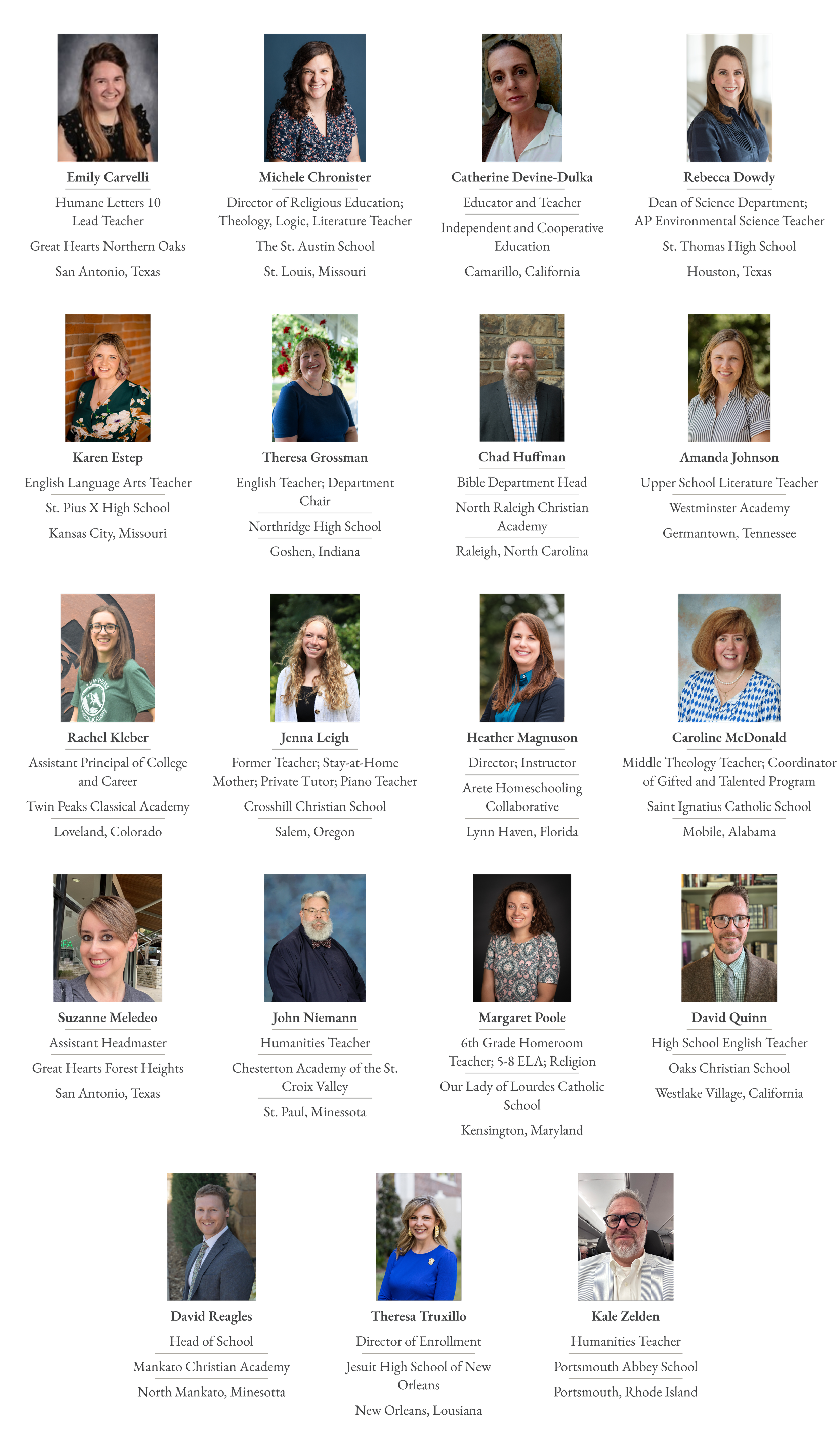
These examples are taken from the applications of two of the nineteen middle and high school educators the McGrath Institute for Church Life is pleased to announce as the AY26–28 Inklings Project Fellows. Drawn from fifteen states and a pool of fifty-eight applicants, these fellows will spend the next two years bringing the work of C. S. Lewis, J. R. R. Tolkien, and their circle to their students, their colleagues, their students’ parents, and the communities around their schools. This is the first time the fellowship has been offered to teachers at this level.
For three years the Inklings Project has run an intercollegiate fellowship for college and university faculty. Thirty-seven fellows from thirty-five institutions in nine countries have designed or redesigned courses on the Inklings, gathered with McGrath Institute faculty and staff each year at the Marion E. Wade Center at Wheaton College, and built a public repository of fifty syllabi. For those fellows the course came first and creative outreach grew from it. That work continues. The plan from the beginning, though, was to cultivate the collegiate faculty first and then, with them, invest in the educators who meet students earlier. Most readers who love these books met them long before college, because a teacher put the right book in front of them at the right time.
The new fellowship gathers especially skilled, creative, and passionate educators to develop their projects together, learning from one another and from scholars who have taught these authors for years. The Inklings themselves are the model: a handful of friends who met weekly to read their work aloud to one another, and out of whose company came The Lord of the Rings and The Chronicles of Narnia. In other words, the Inklings Project treats the Inklings as a method and not only a subject. Teachers must be formed and fed in order to form and feed others. And fellowship is the fertile ground for such work.
The first year of the fellowship is given to formation and design. Fellows take part in three online seminars, one on Lewis, one on Tolkien, and one on pedagogy, each built around assigned readings and each led by a former Inklings Project fellow from the college ranks. Carolyn Weber, author of Surprised by Oxford and 2025–26 fellow, leads the first seminar on November 5. Between seminars the fellows meet in small working groups, and in June 2027 the whole cohort gathers at Notre Dame. The second year is for carrying out the projects, with the cohort still meeting and a final presentation of what was built and what was learned.
What a teacher can do in a school is different from what a professor can do in a department, and in many ways it is more. A teacher sees the same students every day for years, knows their parents, and works alongside colleagues in every discipline. Each fellow applied with the written support of a principal or head of school, and each proposed a creative way to engage the school community in and through the Inklings. Some of the proposals are courses; most are not. All of them are starting points, to be refined over the first year, but they already show the range.
One fellow plans a lecture and seminar series for parents at a classical charter school, on the grounds that parents are the primary educators of their children and deserve the same conversations their children are having in class. An English department chair at a public high school wants to convene teachers from across departments to read The Abolition of Man every other week, in the manner of the Inklings’ Tuesday mornings, as the school works out what to do about artificial intelligence. A middle school writing lab would take Lewis’s “On Three Ways of Writing for Children” as its charter and end the year with an anthology of the students’ own fairy tales. Two schools are considering printed student journals. One fellow is designing an eight-week reading club for foster youth and students in under-resourced schools, written so that other teachers can run it. Another is adapting the texts for students reading below grade level. A senior seminar built on the Inklings’ own habit of small groups would become, in its second year, a workshop for teachers at other schools who want to form groups of their own.
The fellows come from Catholic diocesan and parochial schools, Catholic classical academies, classical Christian schools, public charter and public district schools, a homeschool collaborative, and an independent prep school. Several of them are deans, department chairs, and heads of school. We are glad to have them, and excited for what their students and school communities are about to receive.
Introducing the AY26-28 Inklings Project Fellows:
From Our Fellows
The City That Wrote Itself In
Juliana Dresvina, Ph.D. | AY25-26 Fellow
Lecturer in Cultural History, Stanford University Oxford Program
Last term, walking my history of literature seminar down towards the Radcliffe Camera, I was stopped mid-sentence by a student as she pointed at the eastern facade of the All Souls’ Great Quad. “Are those the Two Towers?” she asked in all earnesty.
I almost tripped over myself and gave her the best – which often means rather disappointing – answer I could, along the lines of “probably not, but nobody is going to stop Oxford claiming them”. Birmingham, after all, has been making its own claim for years: Perrott’s Folly and the great Victorian Waterworks Tower, both familiar landmarks from Tolkien’s youth, are regularly proposed as inspirations. John Garth, whose The Worlds of J. R. R. Tolkien explores the complicated relationship between real places and Tolkien’s imaginary ones, is unconvinced by the theory. Tolkien, true to himself, never confirmed it.
This is what I tell students whenever they ask a version of the same question: only a few things in the Inklings’ books map neatly onto a real place (unless you count Dorothy Sayers as a fully-initiated Inkling). And yet the vibe, the specific, unmistakable atmosphere of Oxford, is everywhere, thick enough that readers keep trying to pin it to a map, like a donkey’s tail.
You can watch the same instinct at work a hundred yards away, in St Mary’s Passage, where tour guides point out a carved lion’s face peering from foliage above a door, two golden fauns, and a lamppost a few steps further on, and tell visitors that here we have the origins of The Lion, the Witch and the Wardrobe. It is a fun, memorable story; it also isn’t, as we all know, the story Lewis told, as Simon Horobin gently reminded us in his recent C. S. Lewis’s Oxford. Lewis’s own account begins with pictures that had lived in his head since his teens: a faun carrying parcels through a snowy wood, a queen on a sledge. And yet, Oxford supplies the myth of its own inspiration more eagerly than the authors ever confirm it.
I hadn’t meant to present the history of fantasy this way. When I first began teaching courses on fantasy in Oxford, the city was very much where the classes happened (one can’t help quote Tolkien’s “both rings were round, but there the resemblance ceased”). We had authors, texts, dates, influences; Oxford was scenery, the academic Hogwarts. But after enough walks and enough student questions, I started to realise that I had got the cast list wrong. Oxford wasn’t staying in the background – it was becoming one of the characters.
Certainly both Tollers and Jack found it difficult to keep the place out of their fiction. Lewis set That Hideous Strength in the invented university town of Edgestow and denied that it was Oxford in its preface, with a firmness that rather invites the response “methinks the lady doth protest too much”. In Tolkien’s unfinished Notion Club Papers, meanwhile, a group of Oxford dons suspiciously reminiscent of the Inklings sit around discussing dreams, time travel, and the drowning of Númenor. Both sang Oxford in verse in their student years, as "Valedictory" and "Oxford" respectively.
Sometimes Tolkien barely fictionalised the landscape at all. Farmer Giles of Ham inhabits a comic “Little Kingdom” recognisably rooted in Oxfordshire: Ham owes something to Thame, while Oxford itself appears as “Oxenford,” home of four exceptionally wise clerks. Tolkien called the Oxford countryside the heart of this Little Kingdom. Middle-earth may well be unmappable, despite detailed hand-drawn maps, but another imaginary country was sitting just beyond the ring road.
And in the slightest and strangest of his posthumous writings, The Bovadium Fragments, published for the first time last year, Tolkien stopped being subtle altogether. Written around 1960 out of a long-running Oxford planning controversy, it imagines “Bovadium” rather prophetically as a lost civilisation whose inhabitants become enslaved to the Motores manufactured at nearby Vaccipratum (Cowley, even now the home of the Mini plant) until traffic chokes their city to death. As a resident of south Oxford, I daily feel the Frodo and Sam’s despair in Mordor in a traffic of Abingdon Road.
The pattern reaches much further back. In the twelfth century Geoffrey of Monmouth produced the first extended narrative of King Arthur’s reign, supposedly writing at St George’s chapel of Oxford Castle. In his Historia Regum Britanniae he presented invented British history with such flamboyant confidence that generations treated much of it as fact. Oxford, it seems, had been manufacturing convincing imaginary worlds long before anybody called them fantasy.
And it still does. Philip Pullman turns Oxford into a city of seductive but compromised power; Samantha Shannon makes it a penal colony run by aliens; R. F. Kuang transforms the University into an engine whose linguistic magic sustains an empire. Each inherits the same city and makes it something stranger, and often more dangerous, than the last.
So when a student asks me now whether those towers are the towers, I’ll start answering differently. Probably not, I’ll say. But ask again in fifty years, once the city has decided what else it wants to have inspired.

Dinner and Dialogue at DiGiulio’s
Christopher Ragusa, Ph.D. | AY25-26 Fellow
Assistant Professor of Moral Theology, Franciscan Missionaries of Our Lady University
In April of 2026, at an event sponsored by the Paula Garvey Manship Humanism Project and in connection with the Inklings Project, several professors from multiple institutions in South Louisiana and 15 students met together over dinner to discuss happiness, suffering, joy, and the understanding of healthcare as a vocation. Students discussed both philosophical texts and comedic film dialogue, which opened up discussions on real life scenarios of loving through suffering, of friendship, and of vocation. Discussions were in equal parts lighthearted and also heartfelt. The little fellowship called itself “Dinner and Dialogue at DiGiulio’s.”
The participating professors represented the disciplines of Nursing and Medicine as well as Theology, Philosophy, and Great Books. They represented institutions including Franciscan Missionaries of Our Lady University (FranU), Louisiana State University (LSU), and Franciscan Missionaries of Our Lady Hospital System (FMOLHS). As a faculty member of FranU and an AY25-26 Inklings Project Fellow, I was one of the co-hosts. Both graduate and undergraduate students from FranU’s nursing, healthcare administration, physical therapy, and nursing anesthesia programs attended.
In preparation for dinner, students read excerpts from Aristotle’s Nicomachean Ethics on happiness as an activity, St. Francis on “True and Perfect Joy,” St. Thomas Aquinas on charity as a special form of love that embraces joy and sorrow, and an excerpt from Woody Allen’s Love and Death (1975). The goal of the evening was to discuss true human flourishing and to provide an opportunity for human formation outside of the classroom that might help people navigate their own future struggles, avoid burn out, and find true peace in serving God in a ministry like healthcare.
In true hobbit fashion, no good conversation was had except over a shared meal. Shared food is often a recipe for shared life and this was certainly the case with the “Dinner and Dialogue” evening.
Quarterly Highlights
Inspiration: “A poet is a man who is glad of something, and tries to make other people glad of it too.” – George MacDonald, At the Back of the North Wind
Resource: In their most recent podcast episode “Homesick for Heaven,” Catholic Stuff You Should Know hosts Father CJ Mast and Father John Nepil talk about what C. S. Lewis calls Joy: that “desire for our own far-off country.”
Event: Fellowship for Performing Arts’ Campus Initiative is bringing FPA’s nationally acclaimed productions to college campuses across the country, and demand has been strong, with some fall performances already sold out. See this semester’s locations and dates below. Campus ministers, faculty, and student leaders interested in bringing a show to their campus can learn more here or contact Whitney Bahr, Campus Initiative Manager, at whitney@fpatheatre.com.
University of Notre Dame — October 29th: The Screwtape Letters at 7:30PM, DeBartolo Performing Arts Center
Rutgers University — November 5th: The Screwtape Letters at 7:30PM, New Brunswick Performing Arts Center
Purdue University — November 11th: The Screwtape Letters at 7:30PM, Loeb Playhouse
Virginia Tech — November 19th: C.S. Lewis On Stage: Further Up & Further In at 7:30PM, Center for the Arts at Virginia Tech,
Interested in supporting the Inklings Project?
The Inklings Project exists because of the generosity of individuals. To make a one-time or recurring donation to the Inklings Project, please visit giving.nd.edu/inklings, or call 574-631-7164.
The University of Notre Dame is a 501(c) (3) tax exempt nonprofit corporation.
For past issues of the Inklings Quarterly, visit www.inklingsproject.org/quarterly.